

Those Mother Frackers...
- Vicki MacHale

- 2 days ago
- 6 min read
How HOA Management Became the Next Target in America’s Corporate Extraction Economy

You have seen it. You have felt it. And you know it is not right.
The local vet you trusted is gone, still smiling, but replaced by a corporate machine wearing the same sign. Prices spike. Diagnostics multiply. Care is driven by quotas. Something is wrong, and you can feel it before anyone explains a thing.
What used to cost $75 is suddenly $400. You cannot afford to treat your pet, and yet you cannot afford to let him die with dignity.
You are not imagining it.
A sophisticated macroeconomic playbook has been quietly reshaping entire industries. It clears out honest competition, engineers hidden fees, and turns everyday life into a revenue stream.
That same playbook has now moved into our neighborhoods.
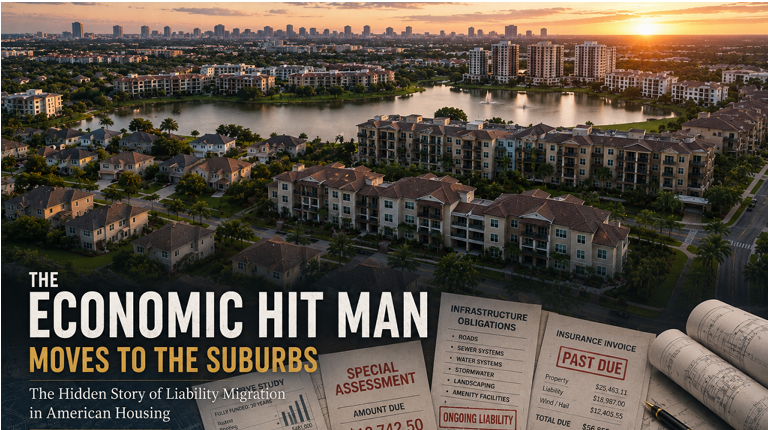
HOA management did not invent this system. It simply adopted a model that was perfected years earlier in housing, pet care, and healthcare. It is a model built for total ecosystem mining.
And it is the architecture being driven in the modern American HOA.
The Broken Plumbing of HOA Contracts
To understand today’s HOA management contracts, imagine a plumbing system.
In a normal system, you flush the toilet, and the waste moves through the pipes. One action completes the loop.
In corporate HOA management, the flush costs extra.
You pull the handle, and nothing moves. The manager explains:
“Using the toilet is included in your base fee, but flushing is an additional charge.”
This is the loss-leader contract.
It was engineered by early-moving corporate giants who realized they could underbid ethical competitors, win the board vote, and make their real money through a multi-tiered extraction stack hidden in the fine print. Once the base fee is locked in, the mining begins.
The Multi-Tiered Enforcement Trap
Charge 1: The HOA Management Agreement: Inspections are included in the base fee. Violation letters are not.
Charge 2: The Homeowner Pays: Each notice triggers a $10 to $25 administrative fee, on top of any fine that may come later.
Charge 3: The HOA Supply Costs: Line-item charges for copies, scans, envelopes, and postage.
Charge 4: The Digital Toll: A convenience fee of $2 to $15 is charged to pay the fine through the portal or app.
Inside the portal, residents are flash-marketed corporate alliances, insurance products, services, and preferred vendors. Every violation becomes a monetized touchpoint, and every loop in the system is intentionally broken. And every broken loop becomes a revenue opportunity.
The Smoke Screen: The Copy Fee Distraction
Management companies absolutely deserve to make a fair profit. That is not in dispute. But the major players have perfected a smoke screen that hides where the real money comes from, while pushing small or ethical companies into shrinking margins just to survive.
If boards had any idea how much their accounts generated, or how that profit was actually extracted, we might have a class action lawsuit on our hands.
Oh wait, we do.
So perhaps we would have more.
When these corporate magicians present their contracts to volunteer boards, the disclosures are engineered to be vague. Exhibit B is simple and familiar. It lists copies for 25 cents per page, and the board fixates on that number. They negotiate it down to 15 cents and feel victorious. Meanwhile, the management company is thrilled. They will gladly give up a few cents on photocopies because the real extraction happens in:
Unbundled service loops
Banking kickbacks
Digital convenience fees
Vendor kickbacks
Data mining
Insurance commission sharing
Float capture
SaaS charges
The negotiation itself is a stage trick.
Learning to Frack
Private equity did not discover HOA management. HOA frackers stole private equity’s playbook first. They gained early market power through aggressive roll-ups, then proved just how fractured, unregulated, and financially ripe the industry really was.
Once the big private equity firms saw the margins, the lack of oversight, and the depth of the pockets involved, the billion-dollar players showed up to build the infrastructure they needed to run yet another market into the ground.
In following the money, it is my opinion that the Surfside tragedy was the final go signal.
After that collapse, the private equity feeding frenzy began in earnest, with billions being offered up like Snickers bars at Halloween.
The Psychological Trap: From Human Tension to Automated Distress
Tension between homeowners and boards has always existed. In the past, a human manager could pick up the phone, talk it through, and resolve the issue.
Today, that human buffer is largely gone, and managers are overloaded with massive portfolios.
A homeowner gets hit with a charge and tries to call management. Instead of a person, they are dropped into an AI phone maze. If they reach a human, it is a different department with no authority. The system isolates, delays, and exhausts.
By the time the homeowner finally reaches a board meeting, they are emotionally frayed. The manager and the defensive board focus on the resident’s delivery, not the substance. They label them the unhinged neighbor and move on. And yes, upset owners are often very frightening. But the distress has become industrialized - not by the board, but by the manner in which HOA management often paints homeowners.
The Legislative Blind Spot
Homeowners are so frustrated that they are bypassing boards and going straight to state legislatures, demanding protection. But the Community Associations Institute, the industry’s legislative voice, is heavily influenced by the same corporate giants driving the extraction model. When consumer protection bills appear, the machine tries to kill them.
And yes, sometimes it is warranted.
However, when public pressure forces a bill through, the corporations pivot.
They publicly denounce the law while privately figuring out how to monetize it.
This is not governance. It is a strategy.
The New Diversion: Hospitality
While the industry faces unprecedented systemic issues, including fraud, burnout, collapsing infrastructure, and automated contract creep, the corporate solution being marketed is hospitality.
Here is your fine. For an extra three dollars and fifty cents, I can provide a bottle of water.
Yes, the administration fee is expensive, but for an additional $5.75, I can recommend a great steakhouse.
The hospitality narrative is a distraction.
The extraction loops remain fully intact.
And we have much bigger issues that need to be addressed, rather than building a new strategy on top of a crumbling one.
The Interlocking Web: The Pet Ecosystem Was a Warning
If you think HOA contract creep is separate from other consolidated markets, you are missing the macroeconomic map. The same financial structures driving corporate vet clinics are deeply interlocked with rental housing, healthcare, dental, and now HOA management. This is one extraction engine replicated across industries, and most of these industries eventually collapse under the weight of the pricing while people struggle and the frackers count their money.
They are in your home.
Really think about that.
The Housing Gate
Institutional landlords unbundled pet ownership.
What used to be a refundable deposit is now:
A non-refundable fee
Permanent monthly pet rent
Charges per animal
Mandatory DNA testing
This is not about risk. It is about extraction.
The Healthcare Gate
Veterinary clinics were consolidated by the same financial sector.
Once the roll-ups gained enough market share:
Prices skyrocketed
Diagnostics were unbundled
Care loops were broken
Revenue quotas were enforced
Bills spiked forty percent
Local companies were driven out of business
The same model now shapes your HOA.
This is not coincidence. - It is design.
The Illusion of Consent
Mega conglomerates have figured out how to financialize the human condition on every level. They write your HOA contract, control your digital access, hold the banking integrations, influence legislation, and hide behind disclosures that no ordinary person can interpret.
HOA attorneys often overlook these structures entirely when reviewing management agreements. When the cracks show, they retreat behind the same defense:
“We did not hide anything. It is all in the contract.”
The same tactic is used on homeowners:
“If you did not like the rules, you should not have moved here.”
But disclosure without comprehension is not transparency.
It is legal entrapment. Volunteer boards are not commercial underwriters, and they can sometimes be easily led. They sign boilerplate agreements without understanding how the hidden loops will function in real-world governance.
That asymmetry is the point.
The Wake-Up Call
The illusion is over.
It is time to stop fighting over photocopy fees and start confronting the architecture of the machine.
This is a call to ethical management companies, honest vendors, exhausted homeowners, and dedicated board members. We cannot stay silent while neighborhoods continue to be financialized.
Share this article.
Send it to your board.
Send it to your neighbors.
Send it to legislators and journalists.
Honest management professionals must use their voice, even if it is quietly, one call at a time. If we want to protect the American neighborhood, we must understand what we are up against.
In this system, none of us is a partner or family.
You are tomorrow’s food source.


Comments