

The Economic Hitman Moves to the Suburbs
- Vicki MacHale

- 2 days ago
- 6 min read
Updated: 2 days ago
How HOAs Became a Ponzi-Like Wealth Machine - Where Early Owners Cash Out and Future Homeowners Inherit the Bill
Ever read Confessions of an Economic Hit Man by John Perkins?
If you haven't, here is the shorthand:
Perkins was a chief economist who blew the whistle on how corporate conglomerates and institutional banking systems intentionally trap developing systems in massive, inescapable debt loops.
They push over-inflated infrastructure projects, siphon the capital out through hidden corporate pipelines, and leave the local population holding an empty bag.
Sound familiar?
It should.
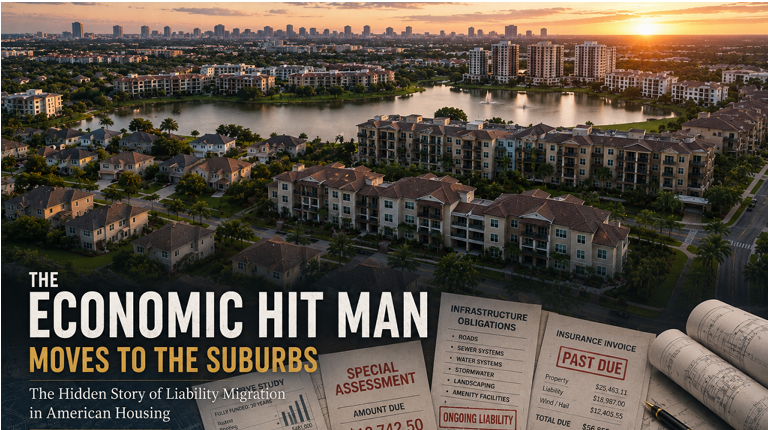
Because the exact same "Economic Hit Man" architecture is likely being deployed within the HOAs through a process of systemic liability migration.
Whether they are backed by Wall Street funds, sheer institutional dominance, or private equity, the biggest names in the sector have turned community housing into a pure wealth-extraction machine.
The Cities expand their tax lines while sloughing off massive public infrastructure liabilities (like roads and sewer lines) onto deed-restricted communities.
The Developers build cheap, dump the initial infrastructure debt into special tax districts running with the land, and cash out clean.
The Elite Management conglomerates deploy their massive corporate market power to quietly hoard the daily transaction float, hide backend rebates, and layer on operational surcharges.
And the only entities in this entire system not making a single dime - but who are completely funding the entire system - are the homeowners represented by volunteer board members.
Well, no money… until they sell. And therein lies the catch.
In order to get your cash at closing, you often have to pass a ticking financial time bomb of underfunded reserves and crumbling infrastructure to the next buyer, and it gets worse with each sale.
And what homeowner doesn't want to make a great return on their investment?
And what vertically integrated management company wouldn't benefit from an industry fragmented across fifty states, governed by volunteer decision-makers who often have little visibility into the financial mechanisms operating beneath the surface?
If you step back and look at it, the outcome can resemble a classic Ponzi scheme.
Early participants extract value through the sale of their homes, while later participants inherit the growing liabilities until one day the money train stops.
Every future buyer down the line unknowingly assumes an exponentially higher layer of hidden structural risk, as reserves are underfunded, maintenance costs increase, and well meaning, and quite lovely Mabel, continues to place her focus on the $2.50 increase for pansies as she really has no concept of running a multi-million-dollar corporation and believes she is protecting it through the counting of pennies.
And then one day the music finally stops.
Reserves are depleted.
Roofs are leaking.
Mandatory inspection deadlines pass.
Fannie, Freddie, & the FHA cut off loan access.
Homeowners are screaming.
Insurance goes through the roof.
The special assessment finally hits and the latecomers with little equity, high mortgages, and no way to sell without a huge loss, if funding is even available at all, are stuck paying for all of those who previously bought and sold their unit and who escaped the community with not only a profit, but never having to pay their fair share.
The only person who really ends up paying their fair share is the first-time home buyer on a unit that never moved and who now may have to dig into their equity.
And if not handled well, while this has been snowballing for decades, the current board is left holding the bag and the rage.
The most vulnerable in this system are condominium owners.
Even when common area infrastructure deteriorates in a single-family home community, an owner can still maintain a safe, habitable home.
When the shared structure fails within a condominium, individual owners cannot simply repair around it, or protect themselves independently.
We're seeing this in real time in Florida right now as the dominoes begin to trickle throughout the U.S.
I'm not theorizing about this from the sidelines.
I lived it in the trenches.
I was the management company owner who navigated the internal storms of two landmark, precedent-setting California appellate cases on a single property: Friars Village v. Hansing (2013) and Lee v. Silveira (2016).
I watched firsthand how a 440-unit community could have its energy, focus, and capital completely swallowed by decades of poor decision-making, board warfare, neighbor-to-neighbor warfare, and expensive litigation while the community continued to degrade, insurance was cancelled, and properties lost their value.
And now we have a whole new threat to the homeowner associations - mega-corporations, industry consolidations, vertical integration, and the arrival of private equity sinking billions into the industry. When private equity and mega-corporations arrive, there is one purpose - revenue. And chaos, deferred maintenance, and a the ecosystem around associations are an unending goldmine of extraction. They know how to extract, they know how to market, and they know how to hide revenue streams.
In the past, the HOA was the client, and the management company made their money off of the management fee and a handful of extras. In today's vertical integration model, they make money off the contract and extras, but they also have the ability to extract money off the money you have in the bank, off insurance commission sharing, off pay-to-play contracts with your vendors, through the technology they provide you, through collections, through the enforcement process, through in-house services, and basically with every person or process that is within the ecosystem of your HOA.
And on the surface, some of the explanations might sound reasonable - but if you know the structure, you know differently.
CAI National is going on right now in Orlando setting the direction of the industry. And if you follow the money and understand the corporate structure, that might give you some insight as to who is will truly benefit underneath the shiny marketing.
The industry focus continues to be on transparency - but transparency for whom? And while the promised technology may be wonderful, be very careful not to get so caught up in the improved process that you don't see what's going on behind the curtain.
Keep this in mind. There is actually more money in chaos and a broken HOA than in a well-run community. And the new companies growing through consolidation, private equity, and launching vertically integrated systems that capture revenue not just from the client, but through every vendor and system within the client's ecosystem, know this. The bank - the insurance company - the landscaper - the technology platforms - their in house services - the payment system - your fractured operations ...
Most managers, and even mid-level executives don't have a clue of how vertical integration works. They are employed, they are often doing the job of two people, and they don't have the time, the insight or the incentive to step back and lift up the curtain.
I talk about this because I see an industry where homeowners are suffering, while management travels down a very dangerous path. It's the 75 million people living in HOAs that will pay the price, because within an HOA homeowners are the only funding source.
I would go as far as to say that the HOA management industry deserves serious antitrust scrutiny.
Our sister industry, multifamily housing, has already been hit with nearly $360 million in antitrust settlements tied to allegations involving rental pricing software, data sharing, and coordinated market behavior. The Department of Justice has also pursued RealPage over alleged anticompetitive practices in rental housing.
Much like HOA management, many multifamily companies grew through consolidation, rely on centralized technology, operate at massive scale, and are backed by private equity or deep financial pockets.
So the question is simple:
Why would we assume similar incentive structures inside HOA management deserve no investigation at all?
I speak out because you can loathe the structural architecture of an industry while deeply caring about the people stuck inside it. Including caring about those management companies, and all of the managers who do their best to support clients every single day in a tough industry.
And this is exactly where I, and a growing number of people willing to look, are sitting right now.
A system of consolidated corporate wealth extraction cannot survive a community that finally understands how it works.
And people deserve to know.
Of course these are only my opinions - they are based off of decades of experience, known practices, and deep industry research.


Comments