

Behind the Pretty Lawns - America's HOA Crisis
- Vicki MacHale

- May 24
- 7 min read

What if the next housing crisis doesn’t start with subprime mortgages?
What if it starts inside America’s HOAs, and we’re already watching it happen?
especially within condominiums.
For years, the industry kicked maintenance, reserves, infrastructure, and financial reality down the road while focusing on pretty lawns, hidden trash cans, architectural violations, and power dynamics to preserve property values.
Meanwhile, boards avoided increases. Homeowners resisted them. Management companies normalized it. Developers moved on. Cities shifted liability. And legislators focused on surface-level governance fights while relying on industry professionals who were often protecting the very income streams built around the system itself.
Now the bill has come due.
And it’s arriving at the exact same moment Americans are being hit with layoffs, inflation, rising insurance costs, economic instability, and the disruption coming from AI.
Millions of people living in HOA communities are one special assessment away from financial devastation.
And circling the wreckage are the new breed of management companies, attorneys, vendors, consultants, reconstruction industries, collection pipelines, and pay-to-play ecosystems positioning themselves to profit from the collapse they helped normalize.
Florida is not an isolated condo problem - Florida is simply the first domino.
Think about this - based on a 2012 report, it is estimated that 74% of associations are underfunded in reserves - 40% of those critically so. But what nobody talks about is that only 10 states actually require a reserve study, so it's possible that 74% is actually a "pie in the sky" number.
What we are seeing there is what happens when years of deferred maintenance, underfunded reserves, political avoidance, and financial denial collide with reality all at once.
And the terrifying part is that Florida is not unique.
California has required reserve studies for years. Florida largely did not until after Surfside. Yet both states are now showing the same fractures underneath HOA living because the issue was never simply reserve study requirements and disclosures.
The issue was funding the reserves and doing the actual work.
Now we have knee-jerk legislation that, on the surface, is addressing the issues, but is at the same time creating even more financial havoc. On top of that, Fannie and Freddie are requiring a 15% reserve funding requirement - which may be a partial pressure relief for some communities - but for others, it's like trying to bail the Titanic with a thimble.
And those who truly understand the industry knew this was a ticking time bomb years ago. So how does an industry call itself successful when, at best, 70% of its clients are in a financial quagmire?
What exactly are the metrics for success?
· Pristine yards?
· Clean common areas?
· The number of violation letters sent?
· The absence of cars parked on the street?
· The number of accounts under management?
· The revenue being generated?
Because any business model that considers itself successful with a baseline 70% failure rate needs to stop and reconsider what it is actually measuring.
For over thirty years, associations waived funding, delayed projects, borrowed from reserves, pushed repairs off another year, and kept monthly dues artificially low because nobody wanted to be the board that raised assessments.
Meanwhile, entire industries financially benefited from the avoidance.
· City governments kept upping the game.
· Developers kept building.
· Management companies kept managing.
· Vendors kept contracting.
· Attorneys kept billing.
· Insurance companies kept insuring.
· Bankers kept banking.
· Reserve Study Analysts kept warning.
· Industry organizations kept driving the agenda.
· Board members kept making poor financial decisions.
· And homeowners kept buying without understanding the system.
And all the while, the corrosion was being hidden beneath the surface as an entire ecosystem of law firms grew out of the ashes to support homeowners trying to fight their way through it.
Some of us have talked about it for years - but only in safe circles outside of watchful eyes.
The problem was that the industry itself did not seem concerned, so a lot of people inside it learned not to be concerned either. Those who did speak up were typically silenced. And through this, the survival strategy of early management companies soldiered on until one day a few really smart people turned it into a money train.
And for those unwilling to trade integrity for hidden profit, simply surviving inside the industry became more important than challenging where the industry was headed - especially when fear of being ejected from the tribe was the result.
HOA management started as more of a cottage industry. Local companies. Local relationships. People trying to figure it out and do the best they can with an imperfect system.
Then the industry grew. And eventually, it hit its own glass ceiling.
That is when the bigger players came in. The mergers. The consolidations. The corporate operators. The business minds. The private equity interests.
And they saw the same fractured industry many of us had been working inside for years. But instead of seeing the pain points as something to fix, they saw the money.
Since the early consolidations of the 2000s, the industry had an opportunity to stop and say, here are the mistakes made, here is where the model is breaking, and here is what needs to be corrected before homeowners are crushed under the weight of it. Instead, too much of the focus became, look at this fragmented industry, look at the recurring revenue, look at the vendor opportunities, look at the collections, look at the reconstruction, look at the management contracts, look at the money to be made.
And somewhere along the way, the pain points of boards, homeowners, and communities became less important than the profit potential sitting inside those pain points. And while the industry continued marketing HOAs as the pinnacle of community living because the lawns looked nice and the trash cans were hidden, many of these associations were slowly sliding toward financial insolvency and into the mouths of the alligators waiting below who are managing under the shiny new extraction model.
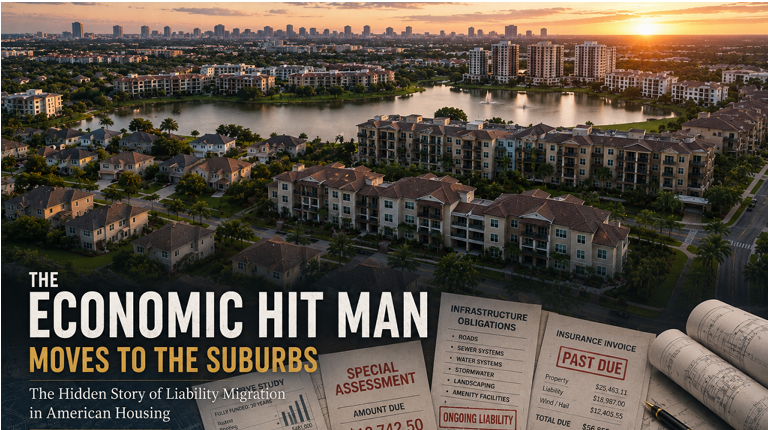
Now associations are being hit with mandatory inspections, structural reserve requirements, insurance explosions, special assessments, rising monthly dues, tighter lending standards, and owners who can no longer afford to stay in homes they already own - yet in many cases cannot even sell and escape.
And unlike traditional mortgage foreclosures that can drag on for years, HOA foreclosures can begin over comparatively small amounts that rapidly snowball through late fees, attorney fees, collection costs, interest, and penalties.
That is not a small problem. More than thirty percent of the country now lives in some form of HOA or common-interest development.
And maybe the bigger problem is not that everyone involved is malicious - because they're not.
It’s that so many people inside the HOA ecosystem exist in a vacuum.
We often see an independent industry survey with approximately 3,000 respondents saying they are generally satisfied with their HOA. But where did that mailing list of respondents come from? Was it from the organization itself? Many have asked - yet nobody knows.
We villainize those “annoying homeowners” who are converging on legislators, joining anti-HOA groups, and cheering for $100 fine restrictions - they continue to be dismissed as grinders, complainers, and people who should have read their documents before they bought - yet their measurable numbers are nearly 1,000,000 and far exceed 3,000 happy homeowners.
When a homeowner fails to put their trash can away, they are fined and told they should have read their documents. Yet board members receive the same governing documents, and have an entire industry built around helping them understand those documents - and when they underfund reserves, defer maintenance, or make poor financial decisions, there is often little accountability unless someone has the time and money to sue.
If it is really as simple as “read your documents,” then why does an entire industry exist around HOAs? It should be simple, right?
Everyone is focused on their individual piece of the system, while very few step back and ask what happens when all of these decisions scale across more than 75 million Americans living in HOA communities.
From inside the vacuum, each decision can look reasonable. From above, it looks like a system eating itself. And I do not speak out about this just to create tension.
I speak out because I still believe there is time to stop the train wreck - but not if everyone keeps defending their individual piece of the system while pretending the whole thing is not shaking underneath us.
This does not get fixed by one board, one manager, one attorney, one legislator, one homeowner, or one industry organization acting alone.
It gets fixed when the people who helped build, manage, profit from, legislate, defend, and live inside this system are willing to stand up to the power players and sit down at the same table and tell the truth about what is actually happening. And maybe part of the reason this is so hard for people to see is that the industry is so fragmented.
One association at a time. One board at a time. One special assessment at a time. One foreclosure at a time. One management company acquisition at a time.
From the ground, it looks isolated - but from above it looks like an industry eating itself - ouroboros.
Maybe people do see it and simply do not care because private equity, consolidation, vertical integration, vendor networks, collection pipelines, and crisis-driven legislation have created the next monetary feeding frenzy, and their smoke and mirrors have our focus elsewhere. But we all know how private equity infusion ends - with a small minority profiting while the rest are left devastated. To think we will be different is simply foolish. Nobody seems to want to say that part out loud. But if we want any chance at stopping this, we must start with the truth.
Stop pretending this is only about bad homeowners, bad boards, or bad managers.
Stop pretending that much of our advocacy is not geared, and driven by industry partner interests.
Require real reserve funding conversations.
Follow the money in vendor relationships.
Bring homeowners, boards, managers, attorneys, legislators, lenders, insurers, developers, and industry organizations to the same table.
Stop measuring success by appearances while communities are rotting financially underneath.
And begin looking at nationwide legislation and accountability instead of continuing with a piecemeal framework of chaos.
Lastly, lobby for and support a full investigation into the new HOA management company extraction model, including pay-to-play alliances, insurance commission sharing, cash payments disguised as earned banking credits, and the ways in which these systems have emerged and financially harmed community associations through layered extraction.
If these practices are serious enough to investigate in industries like healthcare and pharmacy chains such as CVS, then why would HOAs, where millions of Americans are financially captive inside mandatory associations, be exempt from the same scrutiny?


Comments